
Celebrating Our Newest DPhil Graduates: Dr. Xinya Niu, Dr. John O'Sullivan and Dr. Yifu Shi
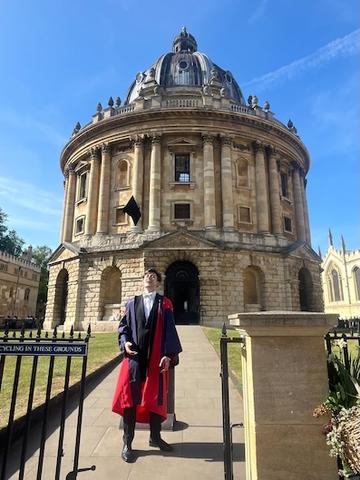
Our group is delighted to celebrate the successful completion of the DPhil degrees of Dr Xinya Niu, Dr. John O'Sullivan and Dr. Yifu Shi, marking an important milestone for both researchers and the group.
Over the past four years, Xinya, John and Yifu have made outstanding contributions to microelectronics and photovoltaic research, advancing both the fundamental understanding of 2D and solar cell materials and the development of next-generation renewable energy technologies.
Dr. Xinya Niu
Supervised by Professor Ruy Sebastian Bonilla, Dr. Xinya Niu's research explored the development of functional charged dielectric nanolayers for semiconductor devices. Her work established new methods for engineering stable charged dielectric films, demonstrated their application to improving silicon surface passivation for high-efficiency solar cells, and pioneered electrostatic p-type doping of two-dimensional MoS₂ without degrading carrier mobility. By combining advanced materials characterisation, interface physics and device engineering, her research provides new strategies for controlling charge at semiconductor interfaces and improving both photovoltaic and nanoelectronic devices.
Xinya has now joined the Oxford Suzhou Centre for Advanced Research (OSCAR) as a Research Scientist, where she is helping establish the Centre's new solar energy laboratory and advancing the translation of tandem photovoltaic technologies towards industrial applications.

Dr. Yifu Shi
Supervised by Professor Ruy Sebastian Bonilla, Professor Peter Wilshaw, and Professor Michael Moody, Dr. Yifu Shi's research focused on advanced compositional and optoelectronic characterisation of high-efficiency silicon solar cells, particularly TOPCon (Tunnel Oxide Passivated Contact) devices. His work combined innovative photoluminescence imaging, electron microscopy, atom probe tomography, elastic recoil detection, and laser beam induced current microscopy to reveal the microscopic origins of energy losses and hydrogen passivation in modern photovoltaic devices. His research has already resulted in multiple high-impact publications and provides valuable guidance for improving the performance of industrial silicon solar cells.
Following his graduation, Yifu has joined Fusion Materials, where he will continue applying advanced materials characterisation to emerging energy technologies.

Dr. John O'Sullivan
Supervised by Professor Ruy Sebastian Bonilla, Dr. John O'Sullivan's DPhil explored graphene transparent conducting electrodes for tandem photovoltaic cells, investigating new approaches to replace scarce indium-based transparent conductors with sustainable graphene alternatives. His research demonstrated how ion-charged dielectrics can dramatically improve graphene conductivity while preserving its excellent optical transparency, bringing graphene closer to practical implementation in high-efficiency perovskite–silicon tandem solar cells. His work has contributed to several influential publications and has strengthened the group's growing research programme in two-dimensional materials and tandem photovoltaics.
We are especially pleased that John will remain with the group as an EPSRC Doctoral Prize Fellow, where he will continue developing next-generation materials and device concepts for high-efficiency photovoltaics.
Looking Ahead
Together, John, Xinya and Yifu have helped shape a vibrant and collaborative research environment within the Electronic and Interface Materials Laboratory. Their work spans semiconductor characterisation, charged dielectric engineering, graphene and two-dimensional materials, silicon photovoltaics, tandem solar cells and advanced interface physics, resulting in numerous high-impact publications and new research directions for the group.
We warmly congratulate Dr. John O'Sullivan, Dr. Xinya Niu, and Dr. Yifu Shi on earning their doctorates and wish them every success as they begin the next chapters of their careers. We look forward to following their future achievements and the continued impact they will have on photovoltaic science, semiconductor materials, and sustainable energy technologies.

