
The Group Presents Latest Research at Conferences
Members of our Electronic and Interface Materials Laboratory recently showcased the group's latest research at three major scientific meetings, highlighting advances in tandem photovoltaics, transparent conducting electrodes, interface engineering, and device modelling.
Over the past months, the group presented research at the tandemPV Workshop 2026 in Berlin, and the Photovoltaic Science, Applications and Technology (PVSAT) Conference 2026 in Newcastle. Together, these meetings provided an excellent opportunity to share our latest results with the international photovoltaics community, strengthen collaborations, and discuss emerging challenges in next-generation solar energy technologies. The tandemPV Workshop brought together more than 200 researchers from academia and industry working on tandem photovoltaic technologies, while PVSAT continues to be the UK's flagship conference for photovoltaic research.
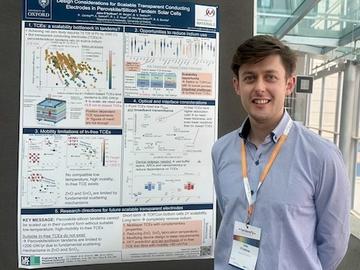
At the tandemPV Workshop in Berlin, Dr. John O'Sullivan presented his latest work on transparent conducting electrodes for perovskite-silicon tandem solar cells, discussing new strategies to overcome one of the major efficiency and sustainability bottlenecks in tandem photovoltaics through improved transparent electrode design.
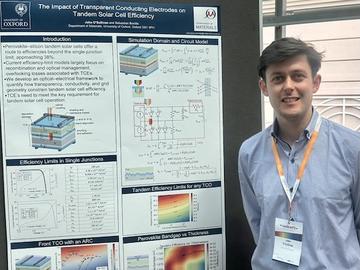
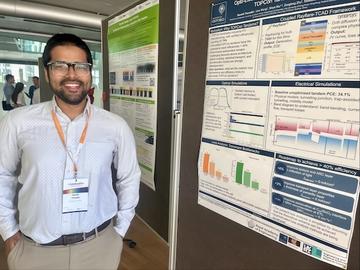
Darshit Trevadia presented his modelling framework for perovskite-TOPCon tandem solar cells, combining optical ray tracing and electrical device simulation to identify the dominant loss mechanisms limiting device performance and to establish realistic pathways towards tandem efficiencies exceeding 40%.
The conference also featured an invited presentation by Theo Hobson, who presented the group's latest research on zinc-oxide contact passivation for perovskite-silicon tandems, highlighting new insights into interface passivation mechanisms that can improve both efficiency and long-term device stability.
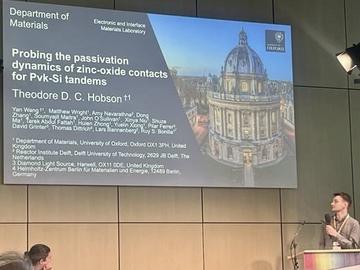
Theo also contributed his newest AZO spectroscopy findings at PVSAT 2026:

At PVSAT 2026, Dr. John O'Sullivan delivered an oral presentation based on the group's recent Nature Reviews Physics article, discussing the role of transparent conducting electrodes in enabling scalable, high-efficiency tandem solar cells and outlining future directions towards sustainable, indium-free photovoltaic technologies.

These presentations reflect the breadth of research within the Electronic and Interface Materials Laboratory, covering topics from fundamental materials physics and advanced simulation through to scalable device engineering and industrially relevant photovoltaic technologies.
Congratulations to John O'Sullivan, Theo Hobson, Darshit Trevadia, and all collaborators involved in these successful presentations. We look forward to sharing the next wave of results as our research continues to advance high-efficiency, sustainable solar technologies.

